
A comprehensive guide explaining the difference between SEO and GEO, and how AI-powered search is transforming the future of digital content and online visibility.
For more than two decades, SEO (Search Engine Optimization) has been the foundation of digital visibility and organic traffic growth. However, with the rise of generative AI platforms such as ChatGPT, Perplexity AI, and Google AI Overviews, the rules of online discovery are changing rapidly.
Today, users are no longer searching only for "links." Instead, they increasingly expect direct, fast, and trustworthy answers. This shift has made the debate around SEO vs GEO one of the most important discussions in modern digital marketing.
As AI-powered search evolves, businesses and content creators are now rethinking how these two approaches will shape the future of content strategy and digital authority.
GEO — Generative Engine Optimization
GEO is an emerging approach focused on optimizing content for AI-generated answers rather than only traditional search engine rankings. This is why companies are beginning to redesign their content strategies to build stronger digital visibility in the years ahead.
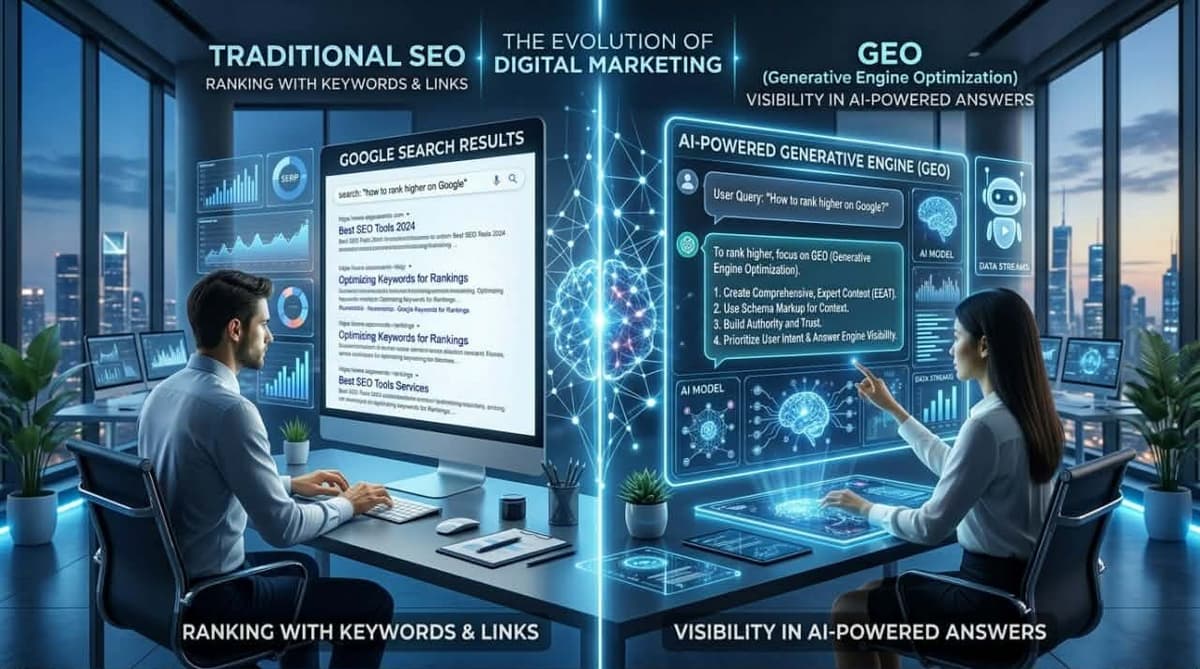
What Is SEO?
SEO (Search Engine Optimization) is the process of improving web pages so they rank higher in search engines such as Google and Bing.
Traditional SEO relies on several core factors:
- Keyword optimization
- Website speed
- User experience (UX)
- Backlinks
- Technical SEO
- Structured content and headings
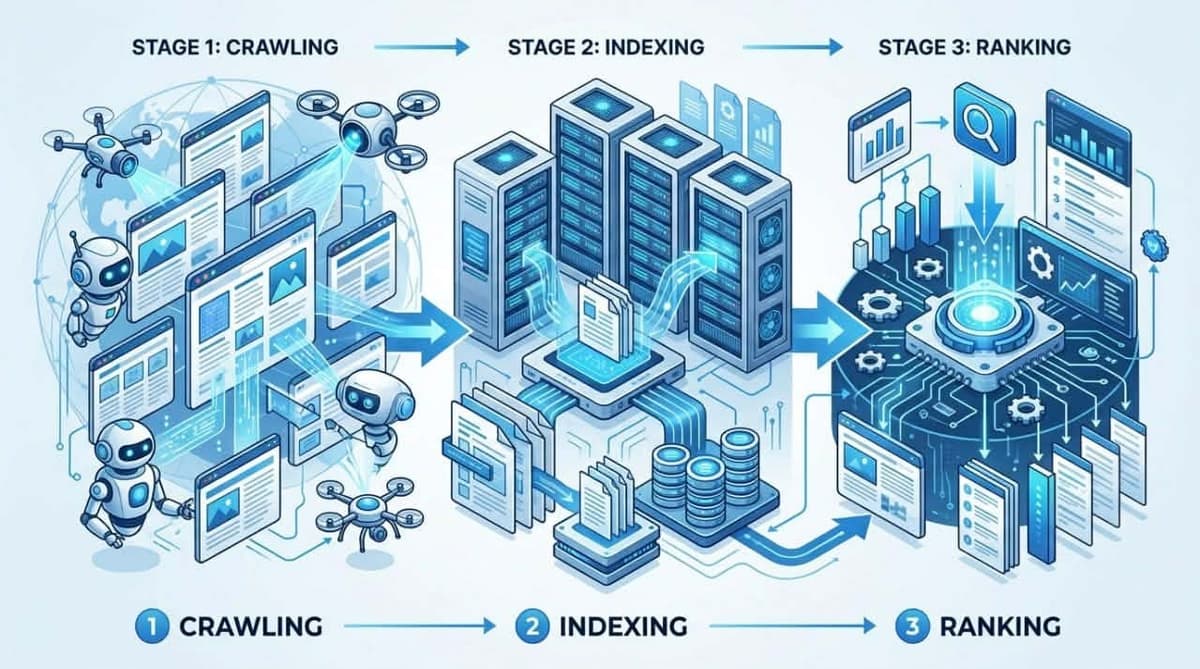
How Traditional Search Engines Work

- Crawling: Search engines discover web pages.
- Indexing: Content is stored and organized in databases.
- Ranking: Pages are ranked based on relevance and quality.
The results are then displayed to users as a list of ranked links.
For years, reaching the first page of Google was the primary goal for most websites and brands. However, the rise of answer engines has fundamentally changed how businesses think about digital visibility strategies.
What Is GEO?
GEO (Generative Engine Optimization) is a modern concept focused on optimizing content for AI-powered answer engines.
Instead of concentrating only on rankings, GEO aims to make content:
- Clear and easy to understand
- Logically structured
- Rich in context and information
- Easy for AI systems to quote and reference
- Trustworthy and source-backed
How AI Search Systems Work
Modern AI systems no longer display only links. Instead, they analyze, interpret, and synthesize content to generate direct responses for users.
In the AI era, the question is no longer: "How do I rank first on Google?" The real question is: "How do I make AI systems trust and reference my content?"
The Real Difference Between SEO and GEO
| Element | SEO | GEO |
|---|---|---|
| Primary Goal | Improve rankings | Appear in AI-generated answers |
| Interface Type | Search results | Direct AI responses |
| Success Metric | Organic traffic | AI citations and references |
| Keywords | Critical factor | Less dominant |
| Content Quality | Important | Essential |
| Backlinks | Strong ranking factor | Lower relative impact |
| Content Structure | Recommended | Absolutely necessary |
This is where the true shift becomes clear. Success is no longer measured only by clicks and rankings, but also by whether content becomes a trusted source for AI systems.
Why GEO Became So Important in 2026
Search engines are gradually evolving from "search engines" into "answer engines."
For example:
- Google introduced AI Overviews
- Perplexity focuses on source-backed direct answers
- ChatGPT has become a search alternative for millions of users
This transformation has significantly changed user behavior:
- Lower click-through rates on traditional links
- Increased reliance on instant answers
- Higher demand for deep, structured content
- Greater importance of digital authority and trust
Multiple industry reports indicate the rise of "Zero-Click Searches," where users get answers without visiting websites directly. This is one of the main reasons why the shift has become a major focus in digital marketing discussions.
A Practical Comparison: Search-Only Content vs Content Optimised for Both
The difference between the two approaches becomes obvious when you compare two pages covering the same topic.
Page One: Traditional SEO Only
The content focuses mainly on:
- Keywords
- Meta descriptions
- Internal links
- Title optimization
However, the article itself remains relatively shallow and is written more for search engines than for real readers.
What typically happens: the page may rank acceptably, but it is rarely cited inside AI-generated answers — simply because it contains no specific claim worth quoting.
Page Two: GEO + SEO Together
The second version adds:
- In-depth explanations and practical examples
- FAQ sections with direct answers
- Comparison tables and concrete numbers
- A clear hierarchical structure
Why it wins: AI systems need something quotable — a number, a definition, or a direct answer. The second page supplies that; the first does not.
A note on method: results vary widely by industry and competition level, and there are no universal figures worth generalising. Measure the impact of these changes on your own site through Search Console and your traffic data, rather than trusting numbers borrowed from studies that do not resemble your market.
How to Create GEO-Friendly Content
1. Write for Humans First
Content written only to satisfy algorithms is becoming less effective. Modern AI systems prioritize contextual understanding and real informational value.
2. Use a Clear Structure
Your content should include:
- H1, H2, and H3 headings
- Tables
- Lists
- Quotes
- FAQ sections
Clear structure counts for little if the page is slow: load speed is a direct ranking factor and affects how often search engines crawl your site. Your platform choice sets that ceiling first — see WordPress vs Next.js and Hosting your site: Vercel or AWS?.
3. Provide Direct Answers
AI systems prefer content that answers questions clearly and efficiently without unnecessary filler.
4. Build Trust and Credibility
Trustworthiness is now a critical ranking factor in modern digital visibility.
- Use official sources
- Add statistics and data
- Include real-world examples
- Build a strong brand identity
5. Focus on E-E-A-T
Google and AI systems increasingly evaluate:
- Experience
- Expertise
- Authority
- Trustworthiness
Will GEO Replace SEO?
The realistic answer is:
No. GEO will become an additional layer on top of traditional SEO.
In reality, GEO still depends heavily on strong SEO foundations because AI systems themselves rely on indexed web content.
SEO + Structured Content + Authority + AI Readability = GEO Success
This is why the conversation is not about replacing one with the other. It is about integrating both into a smarter and more sustainable digital strategy.
The Future of the Web: From Search Engines to Answer Engines

The digital world is rapidly moving toward an "answer engine" era, and this transformation will impact:
- Digital marketing
- Journalism and media
- E-commerce
- Content creation
- Brand building
In the near future, the main question will no longer be:
"Are we ranking on the first page of Google?"
Instead, businesses will ask:
"Can AI systems understand, trust, and reference our brand content?"
Related reading
- Website design cost — placing content optimisation within your site budget.
- WordPress vs Next.js — how platform choice affects performance and search ranking.
- Arabic web fonts — speed is a ranking factor, and fonts are among its heaviest items.
- Hosting your site: Vercel or AWS? — how hosting affects response times.
- Template vs custom design — how design affects conversion rate.
- Web design company in Dubai — if you are targeting the UAE market.
Frequently asked questions
What is the difference between SEO and GEO in short?
SEO aims to raise your page's ranking in traditional search results. GEO aims to make your content quotable inside AI-generated answers from systems like ChatGPT, Perplexity, and AI Overviews. The first is measured in traffic, the second in citations.
Will GEO replace SEO?
No. GEO is an additional layer on top of SEO, not a replacement, because AI systems rely fundamentally on content indexed by search engines. Anyone neglecting SEO in favour of GEO loses both.
How do I make my content quotable by AI?
Write direct, specific answers, include clear numbers and definitions, and structure content with hierarchical headings, tables, and FAQ sections. AI systems need a self-contained sentence they can quote; vague general content does not get cited.
What does Zero-Click Search mean?
It refers to searches where the user gets their answer directly from the results page or an AI-generated response without visiting any website. Its rise means appearing inside the answer itself now matters more than ranking alone.
Do backlinks still matter?
Yes, but their relative weight differs. In traditional SEO they are a strong ranking factor. In GEO their direct influence decreases relative to content clarity, structure, and source credibility — though the authority backlinks build still shapes how much AI systems trust you as a source.
How do I measure GEO success?
No mature measurement tool exists yet as it does for SEO. Practically: watch for referral traffic from AI tool domains in your analytics, test your field's questions directly inside ChatGPT and Perplexity to see whether your content is mentioned, and track impressions in Search Console.
External Sources & References
Conclusion
Traditional SEO alone is no longer enough to build strong digital visibility in the age of AI.
The future belongs to content that can be understood, trusted, and referenced by AI systems, making GEO a critical part of modern digital strategy.
The websites that will succeed in the coming years are those capable of balancing:
- Traditional SEO
- Content quality
- Trustworthiness
- Information structure
- AI readability
This is why understanding both approaches is no longer optional. It has become a strategic necessity for any digital project aiming to compete and survive in the AI-driven future of the web.
Want a site built on these foundations from the start? Get in touch for a free, no-obligation assessment of your current site or next project. See our web development services and previous work.